
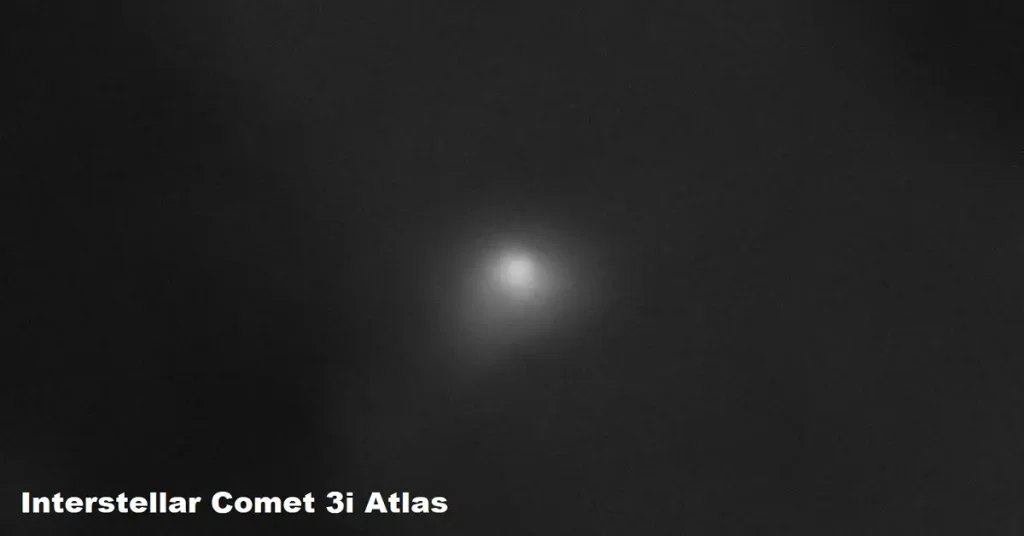
Viral video of comet 3I/ATLAS resembling an alien spaceship sparks AI hoax debate in 2025—real science behind the third interstellar visitor explained.
A captivating video showing the interstellar comet 3I/ATLAS glowing with ethereal streaks of light has taken social media by storm in late November 2025, drawing comparisons to an alien spacecraft. Discovered on July 1, 2025, this third confirmed visitor from beyond our solar system has already fascinated astronomers with its unusual composition and trajectory. Now, the clip—depicting a greenish, paramecium-like object trailing luminous tails—has fueled wild speculation online, prompting questions about whether it’s genuine footage or clever AI manipulation.
As of November 29, 2025, the video has racked up millions of views across platforms like X, blending scientific intrigue with conspiracy theories. For space enthusiasts and casual stargazers alike, it highlights the thrill of interstellar discoveries while underscoring the challenges of distinguishing fact from fiction in the digital age. Let’s explore the comet’s story, the video’s allure, and why experts urge caution amid the hype.
What Is Comet 3I/ATLAS? A Quick Primer on the Third Interstellar Visitor
Comet 3I/ATLAS, the third interstellar object ever detected in our solar system, was spotted by the ATLAS survey telescope on July 1, 2025. It follows in the footsteps of the enigmatic 1I/’Oumuamua (2017) and 2I/Borisov (2019), both of which originated outside our cosmic neighborhood.
Astronomers using the Atacama Large Millimeter/submillimeter Array (ALMA) have found unusually high levels of methanol and hydrogen cyanide in its makeup—far richer than in typical comets. Harvard astrophysicist Avi Loeb, a leading voice in the field, has identified 13 anomalies in its behavior, including six major ones defying easy explanations.
Loeb suggests the comet’s non-gravitational acceleration hints at external forces, possibly positioning Jupiter as a temporary “pit stop” in its journey. Ground-based images reveal a prominent tail and anti-tail, but no high-resolution NASA visuals have quelled public frustration over limited official imagery.
The Viral Video: Why Does 3I/ATLAS Look Like an Alien Spaceship?
The clip in question, shared widely on X, portrays 3I/ATLAS as a glowing entity with multiple light trails emanating from its edges, evoking sci-fi imagery of an extraterrestrial probe. One popular post from November 28, 2025, by user @RealBababanaras asked: “How many of you are tracking the news about COMET ‘3I/ATLAS’? This interstellar object looks like a spaceship.”
The greenish hue and streaky appearance mimic a microscopic organism or futuristic vessel, captivating viewers untrained in astronomy. Such visuals tap into humanity’s fascination with the unknown, especially for objects from deep space that challenge our understanding of the universe.
However, the video’s dramatic flair has raised red flags. Without clear credits or sourcing, it circulates amid a surge in engagement-driven content, where creators exploit scientific buzz for clicks.
Is the Video AI-Generated? Signs Point to Manipulation
Fact-checkers and community notes on X quickly flagged the footage as likely manipulated or entirely AI-created. Common hallmarks include unnatural lighting inconsistencies, overly smooth motion, and the absence of verifiable telescope data matching the depiction.
As of 2025, AI tools like those from Midjourney or Stable Diffusion have made hyper-realistic deepfakes commonplace, often evading initial detection. The video fits this trend: no original poster can be traced, and similar clips have appeared in past comet hype cycles, such as during Borisov’s flyby.
Experts like Avi Loeb emphasize verification through official channels. Loeb himself has debunked comparable fakes, urging the public to rely on observatory data rather than uncredited social media posts.
Real Science Behind 3I/ATLAS: What We Actually Know
Beyond the viral spectacle, 3I/ATLAS offers genuine wonders. Its chemical richness—methanol levels unprecedented in observed comets—could reveal insights into distant star systems’ building blocks. Loeb’s analysis of its acceleration suggests possible outgassing or unseen influences, though natural explanations remain favored.
Telescopes worldwide, including Hubble and James Webb, continue monitoring as it approaches perihelion in early 2026. Ground observations have captured stunning tail formations, confirming its comet nature without the spaceship flair.
For accurate updates, follow NASA’s comet tracker or Loeb’s Harvard updates. These resources provide raw data, helping separate astronomy from algorithmic artistry.
Conclusion: Separating Cosmic Fact from Digital Fiction
The viral video of 3I/ATLAS captures the magic of interstellar exploration, but its probable AI origins remind us to approach online wonders with skepticism. In 2025, as deepfakes proliferate, verifying sources becomes crucial for appreciating real scientific breakthroughs like this comet’s anomalies.
True discoveries, like 3I/ATLAS’s chemical secrets, don’t need embellishment—they’re extraordinary enough on their own.
Have you spotted 3I/ATLAS through a telescope, or fallen for a similar space hoax? Share your cosmic encounters below!
See More: